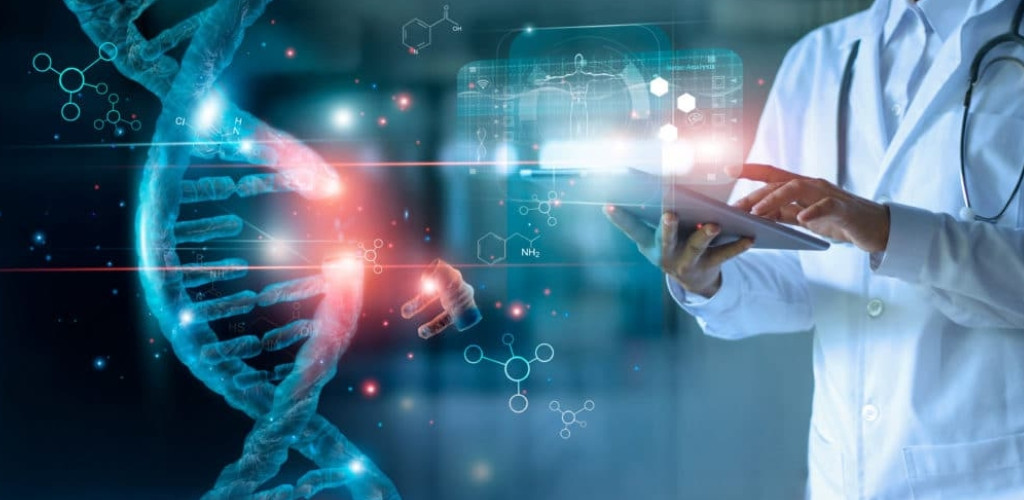
The human body is perhaps the most expansive and intricate library ever conceived. Within its cellular architecture lies a vast, complex narrative written in the four-letter alphabet of DNA, a story spanning billions of bases and containing the blueprints for life, health, and disease. For decades, researchers painstakingly turned these biological pages one at a time. The problem was not a lack of information, but an overwhelming, chaotic abundance of it.
This is the convergence point where Data Science meets Biology, giving rise to the transformative field of Bioinformatics. This is not just a statistical exercise; it is the fundamental shift from treating symptoms to reading the future. Data Science, in this context, is not merely extracting insights from data; it is the Universal Translator and Cosmic Cartographer the specialized discipline required to take the raw, deafening static of biological noise and translate it into actionable, life-saving medical intelligence. This revolution is fundamentally reshaping how we approach diagnosis, treatment, and prevention.
The Cosmic Cartographer: Mapping the Biological Terrain
The first challenge faced by modern biology was scale. A single human genome sequence generates roughly 200 gigabytes of data. When you consider population studies, clinical trials, and proteomics data (the study of proteins), we are no longer dealing with databases, but with oceans of information petabytes that dwarf the capabilities of traditional computational methods.
Bioinformatics specialists are the cartographers of this digital biological terrain. They employ sophisticated machine learning algorithms and high-performance computing to sift through mountains of genomic, transcriptomic, and proteomic data to identify patterns that correlate specific genetic markers with disease susceptibility or drug responsiveness. Without this computational muscle, much of the data generated by next-generation sequencing would remain ‘dark’ or unusable. It is this demand for specialized skills in handling petascale biology that drives the need for rigorous training. Anyone looking to contribute to this cutting-edge research must consider a comprehensive Data Scientist Course designed for complex, unstructured data environments. This foundational knowledge turns raw binary code into meaningful biological pathways.
Decoding the Digital Pharmacy: Drug Discovery Accelerated
Historically, drug discovery was a process fraught with failure, high cost, and immense time commitment, often taking over a decade for a single drug to move from concept to market. Data Science is dismantling this inefficient paradigm by building a “digital pharmacy.”
Bioinformatics models leverage vast chemical libraries and biological network data to perform in silico (computer simulated) high-throughput screening. Rather than testing thousands of compounds manually in a lab, a procedure known as in vitro algorithms can predict potential therapeutic targets, assess molecular interactions, and model drug toxicity before a single drop of liquid is handled. This acceleration cuts years off the discovery process and drastically reduces the cost of failure, allowing researchers to rapidly identify the most promising candidates for treating complex diseases like cancer and neurodegeneration.
Precision Medicine: Tailoring Treatment to the Individual Code
The promise of personalized healthcare is no longer speculative; it is the immediate goal of bioinformatics. Precision Medicine moves beyond the “one-size-fits-all” approach that characterized 20th-century healthcare. Bioinformatics allows clinicians to analyse a patient’s unique genetic profile and the specific molecular signature of their disease such as a tumour to tailor a bespoke treatment plan.
For example, two patients diagnosed with the same type of cancer might have radically different responses to chemotherapy based solely on subtle differences in their germline mutations or somatic mutations. Bioinformatics pipelines analyze these variances to predict which medication will be most efficacious and least toxic for that specific individual. Achieving expertise in these deep diagnostic modeling techniques opens pathways to revolutionary careers. Aspiring professionals seeking to enter this crucial sector often begin their journey by enrolling in a dedicated Data Science Course in Delhi, focusing specifically on healthcare applications and predictive modeling.
The Sentinel Systems: AI in Disease Surveillance and Prevention
The application of bioinformatics extends far beyond personalized treatment; it is rapidly transforming preventative healthcare and public health surveillance. When large-scale outbreaks occur, computational models are essential for tracking pathogen evolution, predicting transmission patterns, and identifying potential future pandemics.
Data scientists build sophisticated epidemiological models that integrate clinical data, geographic information, and genomic sequencing data of viruses and bacteria. These “Sentinel Systems” act as the medical world’s early warning radar, offering the ability to project disease spread weeks or months in advance. The increasing complexity of genetic data generated requires analysts who are not just skilled in statistics but trained in handling complex biological variables. Professionals who have undergone a serious Data Scientist Course are instrumental in ensuring these predictive systems are accurate, robust, and deployable during public health crises.
The Ethical Helix: Navigating Responsibility and Trust
As data-driven medicine becomes prevalent, the ethical considerations surrounding genomic privacy and data bias become paramount. Bioinformatics relies on aggregating massive cohorts of sensitive patient data, making secure storage and anonymization non-negotiable. Furthermore, if algorithms are trained predominantly on data from specific populations, they can inadvertently perpetuate or even amplify existing health disparities.
The next generation of bioinformaticians must, therefore, be technical experts and ethical stewards. They must be equipped to design algorithms that actively mitigate bias and ensure equitable access to these powerful medical technologies. This need for responsible implementation underscores the holistic educational requirements for those entering the field. Demand remains high for well-rounded graduates of a specialized Data Science Course in Delhi who understand not only the code but also the profound societal impact of their work.
Conclusion: The Indelible Convergence
Bioinformatics is not the future of healthcare; it is its urgent present. The marriage of Data Science and biology has transformed the seemingly insurmountable challenge of biological complexity into quantifiable, solvable problems. From accelerating the pace of pharmaceutical breakthroughs to providing hyper-personalized medical care, the Universal Translator of Data Science continues to unlock the deepest secrets coded within human life. The revolution is well underway, promising a world where disease is understood, predicted, and treated with unprecedented precision.
Business Name: ExcelR – Data Science, Data Analyst, Business Analyst Course Training in Delhi
Address: M 130-131, Inside ABL Work Space,Second Floor, Connaught Cir, Connaught Place, New Delhi, Delhi 110001
Phone: 09632156744
Business Email: enquiry@excelr.com
